The 2025-2026 AGSC/Alabama Transfers Annual Report is now available here.

Administrators FAQs
About us
What is the Statewide Transfer and Articulation Reporting System (STARS)?
In November 2022, STARS was rebranded as Alabama Transfers, marking a new chapter in Alabama’s statewide transfer initiative. During its 28 years as STARS, more than 1.6 million transfer guides were obtained by community college students preparing to transfer to Alabama’s public four-year universities.
From 1994 through 2022, STARS stood for Statewide Transfer & Articulation Reporting System. STARS was a web-based database designed to provide guidance and direction to prospective transfer students throughout Alabama. It helped students understand which courses to take at their community college and how those courses would transfer toward a degree at an Alabama public university.
Through the STARS System, students attending Alabama’s public two-year colleges could obtain an individualized Transfer Guide/Agreement based on their chosen major and university. When followed correctly, the guide provided a clear pathway through the first two years of coursework and helped protect students from losing valuable college credit when they transferred.
Today, Alabama Transfers continues that same mission—with an expanded vision for the future. What began as STARS has evolved into a comprehensive statewide resource dedicated to helping Alabama students make every credit count as they move from community colleges to Alabama’s public universities.
Is there a cost or fee to use Alabama Transfers?
Currently, Alabama Transfers is funded entirely through Alabama taxpayer dollars. There is no cost to students or participating institutions for using the Alabama Transfers system and its resources.
The program is funded through a separate line item in the annual budget of the Alabama Commission on Higher Education (ACHE), providing statewide support for Alabama’s transfer students and institutions.
While Alabama Transfers is currently provided at no cost, future funding needs could impact the program’s sustainability. If adequate public funding is no longer available to support the program, a fee for some Alabama Transfers services could be considered in the future.
Who do I contact if I have questions, comments, or suggestions regarding Alabama Transfers?
Get in contact with us through our contact us page. We would love to hear from you.
Does my institution have to participate in this program?
As required by state law, all accredited public two-year and four-year institutions in Alabama that receive state funding are required to participate in the AGSC/Alabama Transfers Program, formerly known as STARS.
This statewide participation ensures that Alabama’s public colleges and universities follow a consistent transfer and articulation process designed to help students move between institutions while protecting their earned college credits.
Does the AGSC mandate the curriculum for all public institutions of higher education in Alabama?
No. The Alabama Articulation and General Studies Committee (AGSC) does not mandate a specific curriculum for all public institutions of higher education in Alabama. However, public institutions that receive state funding are required to adhere to the statewide transfer policies established by the AGSC.
In practical terms, this means that Alabama’s public four-year institutions must honor and accept transfer credit as prescribed by a student’s Official Transfer Guide, in accordance with established statewide transfer policies.
Although the AGSC does not mandate a statewide curriculum, many Alabama public two-year and four-year institutions have aligned their general studies programs with the AGSC’s statewide general studies framework. This framework is organized into Areas I–V, representing approximately 60–64 semester hours of general studies coursework.
What is the Articulation and General Studies Committee (AGSC)?
AGSC stands for the Alabama Articulation and General Studies Committee. The AGSC was established by the Alabama Legislature in March 1994 through Act 94-202 to improve and simplify the transfer of coursework among Alabama’s public colleges and universities.
To fulfill this mission, the AGSC developed and implemented a statewide general studies and articulation program designed to facilitate the transfer of coursework between Alabama’s public two-year and four-year institutions. The program provides a consistent statewide framework to help students transfer college credit and continue their education toward a bachelor’s degree.
The AGSC continues to serve as the statewide oversight and monitoring body for Alabama’s articulation program. Its members work on an ongoing basis to review, maintain, and improve the program and address issues related to statewide transfer and articulation policies. The AGSC also considers and helps resolve student appeals involving the transfer of coursework under the statewide articulation program.
How were the AGSC and Alabama Transfers (formerly STARS) created?
The AGSC and Alabama Transfers (formerly STARS) was created through by the Alabama State Legislature through the passing of Act 94-202.
What are the advantages of a statewide articulation program?
Students and parents benefit.
Having a statewide articulation program that covers the transfer of course credit from one public institution to another can result in huge savings in terms of time and money for both parents and students. For example, if a student takes one or more courses that they believe will transfer and upon transfer finds out otherwise, the student not only loses the money spent on tuition, books, room and board but also must face graduation delays which might result in lost income from future job opportunities.
The public two-year institutions benefit.
In addition to saving time and money for students and parents, the two-year colleges across the state have begun to streamline their course offerings to better match the AGSC approved transfer requirements as prescribed by Alabama Transfers (formerly STARS). The two-year colleges can also provide better and more consistent advising and counseling for their students. Most two-year institutions, if not all, have started to use Alabama Transfers as their primary advising tool.
The public four year institutions benefit.
Now that a state articulation program is in place, four-year institutions can better support transfer students. The four-year institutions are more familiar with which courses they have to take in each of the various majors or programs. In addition, each month every four-year institution receives a list of prospective transfer students who have expressed an interest in transferring to their institution. This list provides the four-year institutions with student names, addresses, e-mails, and phone numbers (if provided). This reporting feature has greatly enhanced the transfer student recruitment process.
The State of Alabama benefits.
The Alabama Transfers program also makes it easier for students to begin and complete their degrees in Alabama. In addition, the state articulation program promotes accountability among the higher education leaders of Alabama. Through this program, millions of dollars are saved each year because students are better informed and they do not waste time and/or money taking courses that will ultimately not count toward their total degree hours.
Alabama is not alone in this effort. Many states have implemented similar state articulation programs. In almost every instance, the benefits gained from such programs far outweigh the costs and difficulties associated in implementing and maintaining such a program.
If you would like to have someone from the Alabama Transfers staff visit your campus and discuss the positive impact that the AGSC & Alabama Transfers Program has had on higher education in Alabama, please contact us.
What are transfer guides and contracts/agreements?
A Transfer Guide is an official document created through Alabama Transfers, powered by the AGSC, that outlines the courses and options a student should complete during the first two years of college before transferring from an Alabama public two-year institution to an Alabama public four-year university.
Each guide includes several sections that identify the general studies and major-related coursework needed for a student’s intended degree pathway. Following the guide helps students understand what courses to take and how those courses are expected to apply when they transfer.
To obtain an Official Transfer Guide, students must use the Alabama Transfers system as instructed. From the homepage, select Option 3 and follow the steps to create a guide based on your intended major and transfer university.
Get an Official Transfer Guide — Select Option 3
If you have questions or need assistance obtaining an Alabama Transfers Guide, please contact the Alabama Transfers office.
Can I use Alabama Transfers if I am attending an Alabama community college and planning to transfer to a private Alabama college or university?
NOTE: Once you click on the links below you will be sent to other institution web pages. You will leave the Alabama Transfers website. We at Alabama Transfers do not guarantee that the information you obtain from these institutions is accurate. Transfer to these institutions is not governed by transfer policies set forth by the AGSC.
Alabama Independent Colleges and Universities
The AGSC/Alabama Transfers is solely funded by state taxpayer dollars and was designed primarily to help students who attend public community colleges in Alabama as they transfer to the public four-year universities or colleges in the state. Therefore, we do not have official transfer guides for students who wish to transfer to or from a private college or university in Alabama. If you are a student looking to transfer to a private college or university in Alabama, we suggest that you work directly with the institution to which you plan to transfer. The links below are provided to help you research and find contacts at these schools. Most of the private colleges and universities in Alabama are members of the Alabama Association of Independent Colleges and Universities (AAICU). You should contact these schools directly to determine their transfer policies and procedures. You should be aware that these institutions may each have different transfer credit hour limitations, or they may have minimum hour requirements that are required in order to receive degrees from their institutions.
Links to AAICU member websites: Amridge University, Faulkner University, Huntingdon College, Miles College, Samford University, Spring Hill College, Stillman College, Oakwood University, Talladega College, United States Sports Academy, University of Mobile, and Tuskegee University.
UPDATE: PRIVATE TRANSFER EQUIVALENCY MATRIX - INITIAL PHASE (4/17/2026)
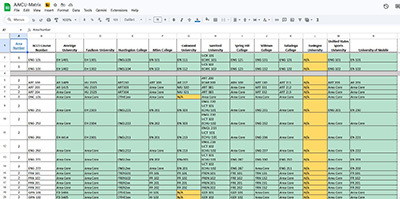
Note: Through our ongoing collaboration with the AAICU, we have nearly completed the initial phase of developing a transfer equivalency matrix for more than 270 courses in the Alabama Community College System. In phase 2, these equivalencies will soon be integrated into our database for a more interactive experience and will be available on the Course Equivalencies webpage.
In the meantime, you can view the current version of the matrix using the link provided below. Please note that the information in the matrix was voluntarily submitted and approved by the registrar at each private institution. Neither the AGSC nor Alabama Transfers guarantees the accuracy of this information.
Students planning to transfer to a private institution should always confirm course equivalencies directly with the receiving institution prior to registering for classes to ensure the credits will apply toward their intended major and degree.
What are Area V Pages and who is responsible for their maintenance?
Area V Pages are web pages maintained by each individual four-year institution in Alabama. Their primary purpose is to give transfer students additional information about coursework at two-year institutions that fulfills Area V requirements—information not covered on the official Alabama Transfers Guide. Four-year institutions also use these pages to share admission criteria for specific academic programs, and may make strong recommendations for courses in Areas I–IV, as long as those recommendations don't limit transfer students' choices in those areas.
Most Area V pages include general information vital to transfer student success, such as:
- Admissions requirements
- Admission application
- Tuition/fee costs
- Financial aid assistance and information
- Links to Area V pages
- Scholarship information
- Advising information
- Current bulletin/catalog
- Links to various departments/colleges
Note: Every Alabama Transfers guide includes a list of institutions offering bachelor's degrees in your chosen major, linked to their websites and Area V pages. Click here to access these pages and other helpful links.
If you have questions about your institution's Area V pages, please contact your Institutional Point of Contact for AGSC and Alabama Transfers matters; they'll reach out to our office if needed.
If you need further assistance, please contact us.
How does using Alabama Transfers protect me?
The Alabama Transfers guides (formerly known as STARS guides) protect students from losing degree credit when transferring to public four-year institutions in Alabama. They also prevent four-year institutions from tacking on extra coursework at the "back end" of a degree, by requiring that transfer students graduate within the same number of hours as native students in the same major.
Are there four-year to four-year transfer guides?
No, Alabama Transfers does not provide individualized transfer guides for four-year-to-four-year transfers the way it does for two-year-to-four-year students. However, students attending a four-year institution can view that institution's approved course listing page to see which courses in their major will transfer to other four-year institutions in the state.
Students considering a transfer from one Alabama four-year institution to another are strongly encouraged to meet with the prospective receiving institution before transferring, to discuss transfer options and course equivalency.
Most four-year universities can also run a "degree audit" of a transfer student's transcript, providing feedback on course equivalency and progress toward a specific major or degree.
What if I want to transfer to a private college or university in Alabama but I can't find the institution on the Alabama Transfers Guide system?
NOTE: Once you click on the links below you will be sent to other institution web pages. You will leave the Alabama Transfers website. We at Alabama Transfers do not guarantee that the information you obtain from these institutions is accurate. Transfer to these institutions is not governed by transfer policies set forth by the AGSC.
Alabama Independent Colleges and Universities
The AGSC/Alabama Transfers is solely funded by state taxpayer dollars and was designed primarily to help students who attend public community colleges in Alabama as they transfer to the public four-year universities or colleges in the state. Therefore, we do not have official transfer guides for students who wish to transfer to or from a private college or university in Alabama. If you are a student looking to transfer to a private college or university in Alabama, we suggest that you work directly with the institution to which you plan to transfer. The links below are provided to help you research and find contacts at these schools. Most of the private colleges and universities in Alabama are members of the Alabama Association of Independent Colleges and Universities (AAICU). You should contact these schools directly to determine their transfer policies and procedures. You should be aware that these institutions may each have different transfer credit hour limitations, or they may have minimum hour requirements that are required in order to receive degrees from their institutions.
Links to AAICU member websites: Amridge University, Faulkner University, Huntingdon College, Miles College, Samford University, Spring Hill College, Stillman College, Oakwood University, Talladega College, United States Sports Academy, University of Mobile, and Tuskegee University.
UPDATE: PRIVATE TRANSFER EQUIVALENCY MATRIX - INITIAL PHASE (4/17/2026)
Note: Through our ongoing collaboration with the AAICU, we have nearly completed the initial phase of developing a transfer equivalency matrix for more than 270 courses in the Alabama Community College System. In phase 2, these equivalencies will soon be integrated into our database for a more interactive experience and will be available on the Course Equivalencies webpage.
In the meantime, you can view the current version of the matrix using the link provided below. Please note that the information in the matrix was voluntarily submitted and approved by the registrar at each private institution. Neither the AGSC nor Alabama Transfers guarantees the accuracy of this information.
Students planning to transfer to a private institution should always confirm course equivalencies directly with the receiving institution prior to registering for classes to ensure the credits will apply toward their intended major and degree.
Term & effectiveness
What are AGSC Institutional Points of Contact and what are their roles and responsibilities?
During the 2002–2003 academic year, the Alabama Articulation and General Studies Committee (AGSC) commissioned an outside evaluation that identified a need for improved communication and coordination between the AGSC & STARS Office and Alabama’s public two- and four-year institutions.
To address this need, the AGSC established Institutional Points of Contact (POCs) at each institution impacted by the work of the AGSC and STARS. These individuals serve as the primary campus contacts for AGSC and Alabama Transfers matters and help facilitate communication between their institution and the Alabama Transfers office.
Institutional Points of Contact play an important role in keeping their campuses informed about AGSC and Alabama Transfers initiatives, activities, policies, and action items.
Click here to view the current roles and responsibilities of Institutional Points of Contact and access the current listing of individuals serving in this role at Alabama’s public institutions.
How Long Is an Official Transfer Guide Valid?
Once submitted, an Official Transfer Guide must be honored for four years by all Alabama public universities that offer the specified major.
There is one important exception. If a recognized accrediting body, regulatory agency, or other governing organization requires academic or curricular changes that apply to all students—both native students and transfer students—in a particular field of study, those requirements must be followed. In such cases, transfer students and native students must be treated equally and comply with the new academic requirements.
For example, changes resulting from a federal or accreditation mandate may require institutions to modify degree requirements for all students, regardless of whether they began their education at that institution or transferred from another college or university.
What are the time limits on Alabama Transfers Guides under which catalog do students graduate?
How Long Is an Alabama Transfers Guide Valid?
An Alabama Transfers Guide is valid for four years from the date it is generated through the Alabama Transfers website. During this four-year period, the guide must be honored by Alabama public institutions of higher education that offer programs in the specified discipline.
Students should keep a copy of their Official Transfer Guide for their records and future reference. The guide remains valid as long as the student continues in the major or discipline specified on the guide. If a student changes majors, a new Official Transfer Guide should be obtained.
Changes required by an accrediting agency, regulatory agency, or other governing organization may result in additional requirements being added to the Transfer Guide. Likewise, if an institution changes the requirements of its degree program, those changes will apply to transfer students in the same manner as they apply to students who began their studies at that university.
Which Catalog Requirements Apply?
The catalog in effect when a student generates an Official Transfer Guide generally establishes the catalog requirements that guide the student's degree progression at the receiving four-year institution. However, a transfer student may choose to graduate under the catalog in effect at the time of transfer if those requirements are more beneficial to the student.
In either case, students should work closely with their academic advisor to understand which catalog requirements apply and to make informed decisions about their degree plan.
What if I experience technical difficulties when using Alabama Transfers?
If you run into any technical issues while using this site, please contact us. Including a description of the problem on the contact form will help us look into the issue and find a solution more quickly.
How frequently is transfer information updated on the Alabama Transfers Guide and how do I know when something has changed?
Since all Alabama Transfers Guides are based on current curriculum standards set by the various academic committees, this information is subject to periodic change. In most cases, updates are reflected on Alabama Transfers a few days after each regular AGSC meeting (held every 3–4 months). When circumstances require it, however, Alabama Transfers staff can often make changes outside this cycle.
To stay informed about updates affecting the Alabama Transfers Guides, visit our system updates page. Each time our office changes or updates a transfer guide, we'll post a summary of that change there.
Note: All two-year and four-year institutions are responsible for periodically checking for these updates so they can revise their Area V pages accordingly, if needed.
What recourse do students have if they feel their Transfer Guide is not being honored?
If you have questions or concerns, or you feel your transfer guide isn't being honored, please contact us for assistance.
Course requirements
How will the University of Alabama's general education curriculum changes, effective Fall 2025, impact credits earned in Areas II and IV?
Changes to the general education curriculum at The University of Alabama are moving forward and are expected to be in place by Fall 2025. Transfer students who follow the official Alabama Transfer Guides will still be on track. For example, earning 12 credit hours in Area II and another 12 in Area IV will satisfy UA’s general education requirements in Humanities/Fine Arts/World Languages/Literature and History & Social/Behavioral Sciences. These 24 hours of credits will fully count toward the transfer student's degree at UA (just as they do now).
Still have questions?
If you’re a transfer student—or the parent of one—and have more questions, you're encouraged to contact the Office for General Education in the Office of Academic Affairs. Dr. Erik Peterson (elpeterson@ua.edu) and his team are available to assist with any questions about the updated curriculum.
You can also stay informed by visiting the official UA General Education website: https://provost.ua.edu/built-by-bama/

Admissions
Do my grades matter?
Yes. Your grades can affect several important aspects of your transfer and degree completion.
First, your grades may affect your eligibility for admission to your desired university and to certain upper-level majors or academic programs. Each institution and program may establish its own admission requirements.
Second, your pre-transfer coursework and GPA remain part of your academic record at the receiving university. The university will determine how your transfer GPA is incorporated into its policies for calculating your overall or graduation GPA.
Third, if your grades do not meet the receiving university’s minimum requirements for transfer credit, you may not receive credit for those courses and may be required to retake them. Each university determines how it handles D grades for transfer coursework. However, the policy must be applied consistently to both native and transfer students at that institution.
I completed all the course requirements. Does that mean I’ll be admitted to my desired university?
Congratulations on completing your course requirements! You have taken an important step toward transferring and completing your degree.
However, completing an Official Transfer Guide does not guarantee admission to a university, a specific major, or a particular academic program. You must still meet the admission requirements established by your desired university and, when applicable, the requirements for your intended major or program.
For information about admission requirements, visit the website of the university you plan to attend. For convenient access to admission information and other helpful resources, visit our Participating Institutions page.
If I generate an Alabama Transfers guide, will it guarantee me admission to my desired college, university, or degree program?
No, generating a transfer guide will not guarantee admission to any college or university, or any specific majors or degree programs. The transfer guides only serve to assist you in planning your course of study prior to transferring to a public four-year university.
We strongly recommend that you meet regularly with your advisor to plan for transfer, including researching your desired institution's and/or degree program's admission requirements, deadlines, scholarship opportunities, etc.
We also recommend that you communicate directly with your desired four-year institution well in advance of transferring. Talk with an admissions counselor, schedule a tour, and schedule a meeting with an advisor from your desired major. The earlier you plan for transfer, the better prepared you will be when that time comes.